
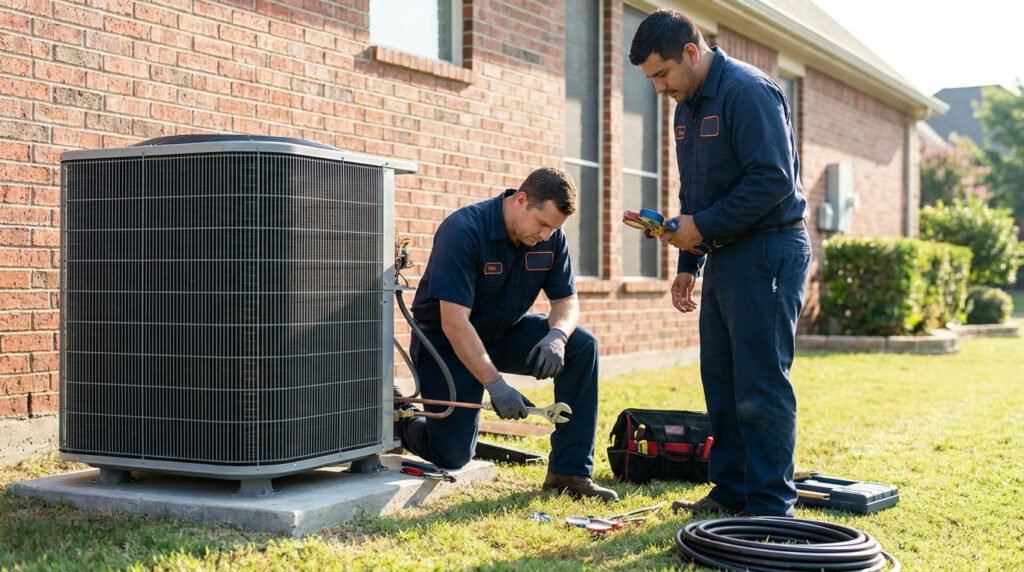
AC replacement in DFW is a decision most homeowners put off one summer too long. With North Texas heat pushing systems past 100°F for weeks at a time, an aging unit doesn’t fail gently — it fails on the hottest day of July, when every contractor in the metroplex is booked solid. This guide shows you how to spot the warning signs early, compare real 2026 replacement costs, and replace on your schedule instead of your AC’s.
Repair or replace? Start with the $5,000 rule
HVAC pros use a simple gut-check: multiply the age of your AC by the cost of the repair. If the result is over $5,000, replacement is usually the smarter spend. A $700 compressor-adjacent repair on a 10-year-old system scores $7,000 — that money belongs in new equipment, not old.
The rule works because both numbers measure risk. The older the system, the more likely this repair is the first of several. Most units installed in DFW’s early-2010s building boom are now 12–15 years old — right at the end of the typical Texas lifespan, which heavy cooling seasons shorten to 12–15 years instead of the 15–20 you’d see up north.
Not sure what the repair should cost? Our diagnostic service pinpoints the failure and gives you both numbers — honest repair quote and replacement quote — so you can run the math yourself.
7 signs you need AC replacement in DFW
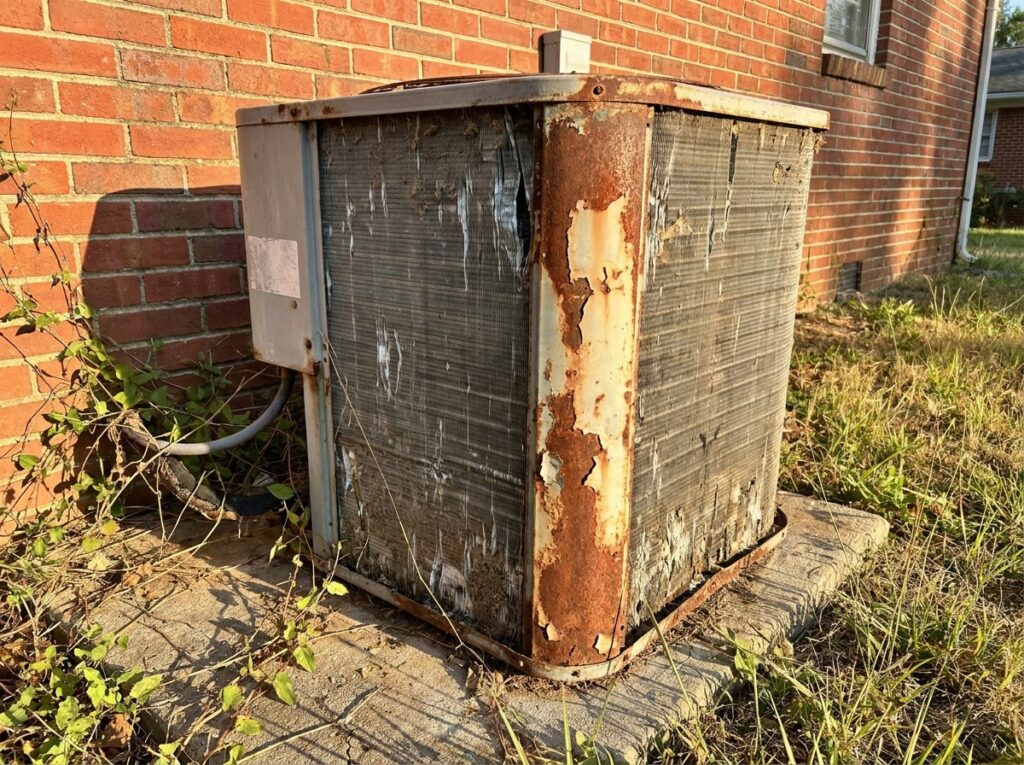
- It’s 12+ years old and struggling. If your system was installed before 2014, it likely uses phased-out R-410A (or even R-22) refrigerant — and every year of Texas heat has aged it faster than the nameplate suggests.
- Repairs are getting closer together. A capacitor one summer, a fan motor the next, a refrigerant leak after that. Frequency is the tell — components fail in clusters as systems age.
- Your electric bill keeps climbing. If summer bills rise year over year with the same thermostat habits, your AC is losing efficiency internally. Old 10–12 SEER units can cost 30–40% more to run than a new 16 SEER2 system.
- It can’t hold temperature after 4 PM. A system that cools fine at breakfast but loses ground all afternoon is undersized, worn out, or both — the brutal DFW afternoon load exposes weak equipment first.
- Humidity feels wrong indoors. Clammy air at 74°F means the system is no longer running cycles long enough to dehumidify — a classic symptom of a failing or oversized unit.
- It needs a major component. Compressor, evaporator coil, or condenser coil failures on an out-of-warranty unit almost never justify the spend versus replacement.
- It’s loud. Grinding, screeching, or a hard buzz at startup are mechanical end-of-life sounds, not quirks.
One or two mild symptoms? A quality AC repair may buy you a few more seasons. Three or more — especially with a unit over 10 years old — and you’re paying premium prices to rent time on borrowed equipment.
What AC replacement costs in DFW in 2026

For a typical DFW single-family home, a complete system replacement (condenser + evaporator coil or air handler, installed) lands in these ranges in 2026:
- Entry tier (14.3–15.2 SEER2, single-stage): roughly $6,000–$8,500 — reliable cooling, federal-minimum efficiency.
- Mid tier (16–17 SEER2, two-stage): roughly $8,500–$11,500 — the sweet spot for most North Texas homes; noticeably lower bills and better humidity control.
- High tier (18+ SEER2, variable-speed): roughly $11,500–$15,000+ — quietest operation, tightest temperature control, biggest long-term savings.
What moves the number: tonnage (a 2,800 sq ft home needs more capacity than a 1,400 sq ft one), furnace or air-handler condition, line-set and electrical updates, and — the one nobody budgets for — ductwork condition. Strapping a new high-efficiency system to leaky ducts throws away the efficiency you just paid for.
Don’t buy on price alone. The cheapest bid usually skips the load calculation and reuses every existing component it can. An improperly sized system short-cycles, dehumidifies poorly, and dies young — see our 2026 installation cost & brand guide for how to compare bids line by line.
What a new system actually gets you
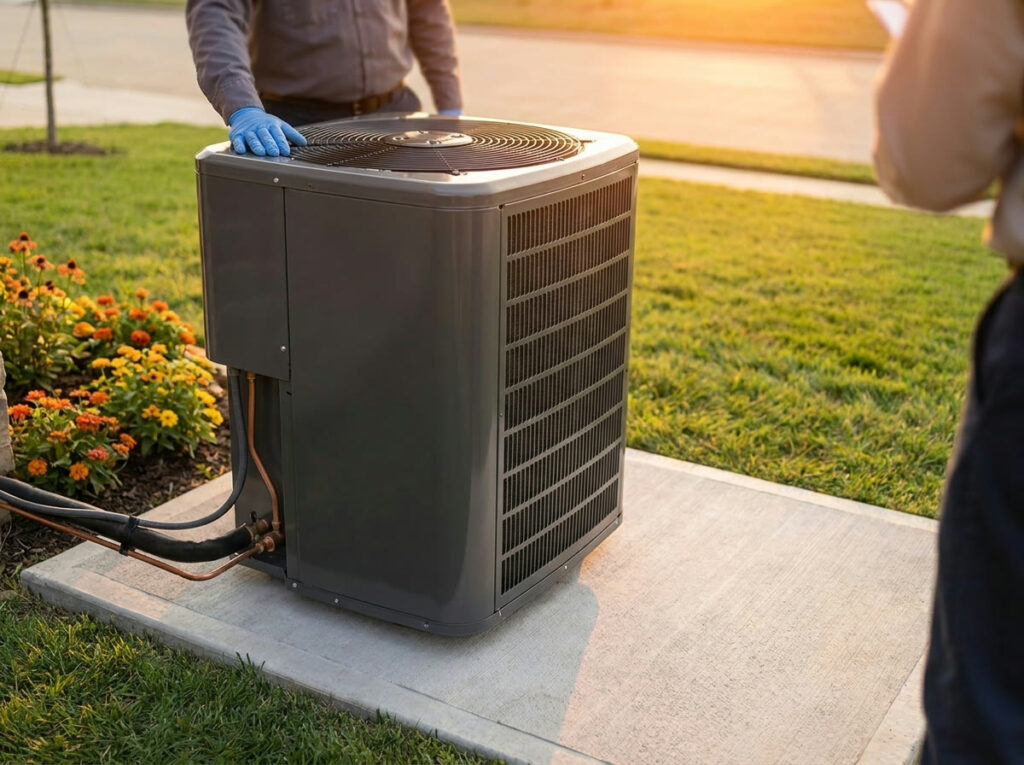
Replacement isn’t just “cold air again.” Moving from a tired 10–12 SEER unit to a modern 16+ SEER2 system typically means:
- 20–40% lower cooling costs — real money in a climate with five months of serious cooling load.
- Even temperatures and real humidity control — two-stage and variable-speed systems run longer, gentler cycles that wring moisture out of Texas air.
- A 10-year parts warranty on registered equipment — versus zero coverage on your current unit.
- Quieter everything — new condensers run at conversation volume, not leaf-blower volume.
- Smart-thermostat compatibility — scheduling and remote control that older single-stage systems can’t fully use.
To protect that investment, pair the new system with seasonal preventive maintenance — it keeps the warranty valid and the efficiency you paid for.
What replacement day looks like with Tori Air Solution
Most AC replacements we do across Grand Prairie, Arlington, Irving, and the greater DFW metroplex are completed in a single day:
- Free in-home estimate: we measure, run a Manual J load calculation, inspect your ducts, and quote good/better/best options — in writing.
- Morning of: old equipment is recovered (refrigerant reclaimed legally), pads and connections prepped.
- Installation: new condenser and coil set, new line set or flush, electrical and drain updates, full commissioning with refrigerant charge verified by measurement — not by guess.
- Walkthrough: we show you the system, register your warranty, and haul away the old unit.
You get cold air the same evening — and a system sized for your house, not for whatever was on the truck.
Frequently asked questions
How long does AC replacement take in DFW?
How much does AC replacement cost in DFW in 2026?
Should I replace my AC before it fails completely?
What SEER2 rating should I buy in Texas?
Does AC replacement include new ductwork?
Get a straight answer on repair vs. replace
Free in-home estimate, honest math, and good/better/best options in writing. Tori Air Solution serves Grand Prairie and the entire DFW metroplex — usually same week.